
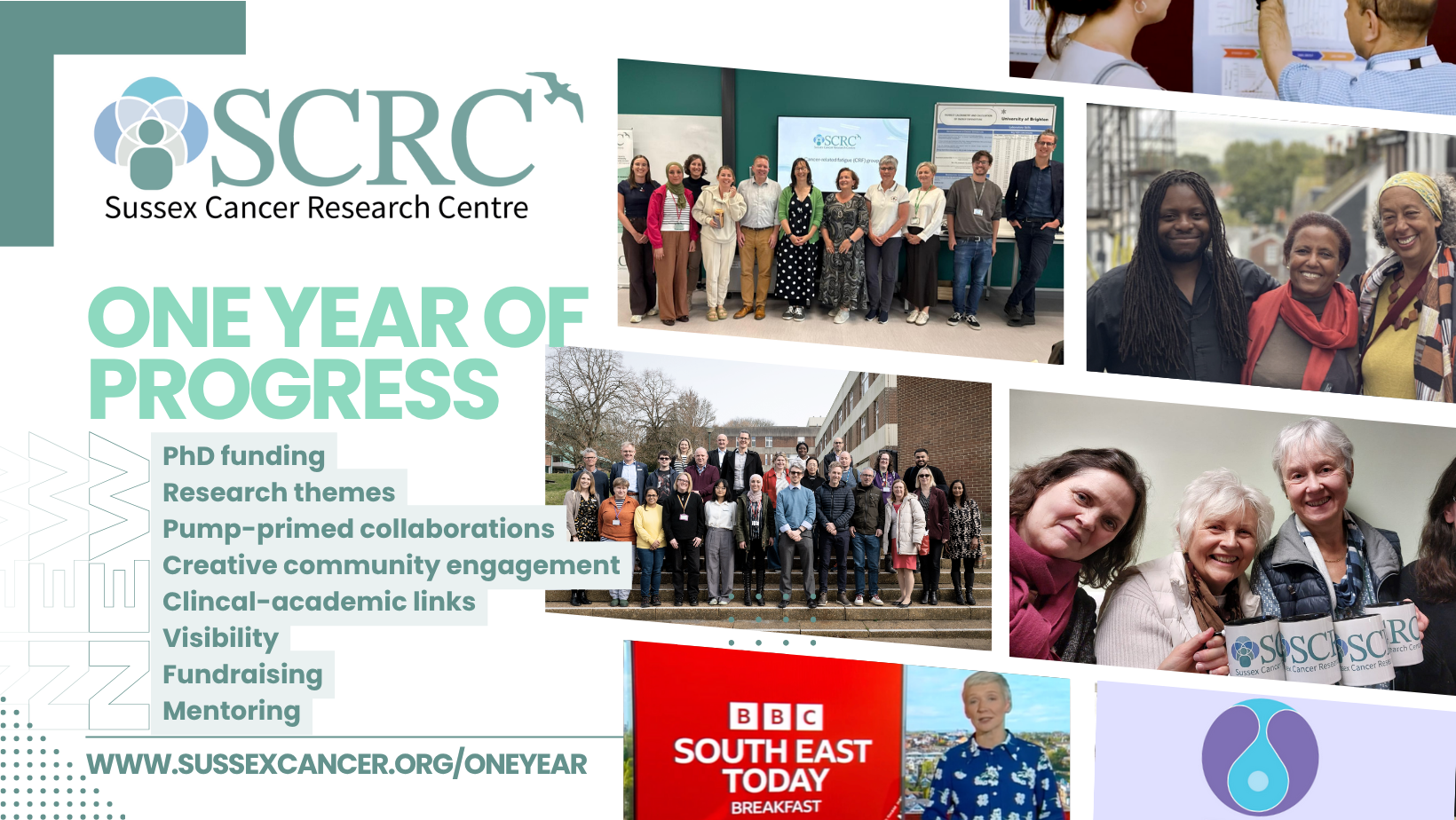
One year ago, with support from a large community of researchers, health care professionals and people with experience of cancer, we launched the Sussex Cancer Research Centre (SCRC). Our central aim is to bring together cancer scientists, clinicians, allied health professionals, and people with lived experience to pioneer interdisciplinary research that improves treatment and outcomes for people with cancer.
We draw on expertise from Brighton and Sussex Medical School (BSMS), the Universities of Brighton and Sussex, University Hospitals Sussex NHS Foundation Trust (UHSx), neighbouring hospitals, and industry partners. Importantly, our work is shaped at every level by people impacted by cancer.
So, one year on—how are we doing?
Our goals for year one

At the launch of the SCRC, together we set out the below aims for the centre. Click on each aim to read how we are delivering on our shared vision.
-
Our first goal was to centre people with lived experience in all we do.
Driven by our lived-experience lead Markus Taylor and our partners at the Sussex Health and Care Research Partnership, the Research Engagement Network, and Diversity Resource International we are developing an inclusive and sustainable community engagement strategy. Find out more about our community engagement plans here.
We also embraced creative approaches to enable the voice of those with lived experience to be central to cancer research across Sussex. We awarded two Creative Community Engagement awards. Click on each one to find out more:
-
We also aimed to become fully integrated into our member institutions and obtain support for pump-priming new research. We’re hugely grateful to the leadership of the universities and NHS Trusts across Sussex for their commitment and support.
-
We wanted to give your research the visibility it deserves—so we launched sussexcancer.org. It’s your hub for research news, directories, and lived experience stories.
Our presence is growing on social media, with over 1,000 followers across the below platforms:
Our newsletter provides regular updates to over 300 subscribers with our latest news, opportunities for researchers, and the latest opportunities for our community to get involved.
In our first year, we’ve also received substantial press coverage, across TV, radio, and online.
-
We wanted to make sure that trainees and early-career researchers could access mentorship—regardless of where the best mentor might be. Our cross-institution mentorship scheme is up and running, open to new mentors and mentees.
Our mentorship goes beyond ECRs and PhDs. Everyone who applies for funding from the SCRC gets detailed feedback and many applicants receive follow on meetings to identify ways to shape applications into internal and external research funding applications.
-
We have created a hub to highlight our shared resources, along with key contacts to facilitate inter-institutional communication.
Our new directory linking researchers to their thematic areas—makes it easy to connect across the SCRC.
Based on feedback from the community it was decided that the best format for meetings was an annual symposium, combined with more frequent themed meetings.
Keep reading to find out more about our new research themes!
New and emerging research themes, united by the Sussex Cancer Research Centre.
The SCRC is builing on a strong foundation, with existing research strengths including:
As we unite researchers across Sussex a number of new and exciting research strengths have emerged. These were driven by feedback from those with lived-experience of cancer who shape our research priorities.
-
Many people with experience of cancer list fatigue as a top concern. The Fatigue Research Group, led by Sally Wheelwright, brings together patient-reported outcome experts at SHORE-C, researchers in the School of Sport, Education & Health Sciences at the University of Brighton, and scientists at the University of Sussex.
They recently held a successful kickoff workshop at the University of Brighton which is leading to new exciting research directions.
-
Dr Stephen Robinson launched the Sussex Brain Tumour Research Group, which held its inaugural event with external speakers and researchers from across Sussex. This attracted leading researchers from across the country and generated a lot of momentum for brain cancer research in the region.
-
The Breast and Gynaecological Cancer Research Group, led by Professor Melanie Flint, brings together expertise in stress, molecular biology, clinical trials, and patient-reported outcomes.
-
The Computational Cancer Research Group, led by Dr Frances Pearl, brings together AI, machine learning, and computational biology experts to support data-driven cancer research across Sussex.

Sussex Cancer-Related Fatigue Group

Sussex Brain Tumour Research Group
You shaped the Sussex Cancer Research Centre
At our launch last year, we asked you: what are the biggest challenges or missed opportunities for cancer research in Sussex?

Live feedback during the SCRC launch event was supplemented by offline feedback in the weeks following the launch.
Top of the list was funding—especially the difficulty in accessing funding across institutional boundaries. This year, we pump-primed five new cross-institutional research projects. These were selected for their scientific excellence, potential impact, and capacity to join the dots on the bench-to-bedside cancer research landscape across Sussex.
Another top priority was funding more PhD studentships. This year, we funded three PhD projects. We are proud to have been able to support both innovative research and three new research careers here in Sussex.

The collaborative networks enabled by SCRC funding in our first year: Each arrow represents collaborations between institutions that were funded by the SCRC in its first year.
Thank you
None of this year’s progress would be possible without all of your ideas, engagement, support, vision, and generosity. Generous support from our institutions, visionary philanthropic support, and a strong partnership with the Sussex Cancer Fund have been essential for the success of the SCRC and all the research progress it is enabling. Thank you.

Looking Ahead
We have a number of exciting updates to share as the SCRC continues to grow, shaped by your input:
-
We are excited to be able to announce new research funding, enabled by the Sussex Cancer Fund.
Details coming soon!
Check our funding page for details, and keep an eye on the newsletter.
-
After engaging with diverse communities across Sussex, it is clear that there is overwhelming desire to engage with cancer research. This is combined with a strong call for equal partnerships between researchers and communities participating in and benefitting from research.
This is why we are announcing the SCRC Community Pledge, which commits us to the below:
Every community member involved in research will receive updates on the outcomes of the research they participate in, and acknowledgement of their contributions.
We will present cancer research in communities across Sussex.
People with lived experience of cancer will be partners in our decision making.
-
We will soon be seeking volunteers for our lived experience and community engagement group: “Experts by experience”.
Roles will include:
Involvement: provide valuable input into research bids
Engagement: be kept informed of research
Partnership: shape our strategic decisions
Dissemination: share the latest research with your community
Keep an eye on the website and newsletter for application instructions.
-
Feedback from communities made it clear that the main motivator for participaction in research is the desire to see change. Change to cancer treatments/care frequently means policy change. This is why we have established the SCRC Policy Initiative, to ensure our research generates evidence that can be used to drive policy change.
Supported by the University of Brighton and in partnership with Diversity Resource International and our lived-experience lead.
We’ve also identified the following priorities for the years ahead:
Initiate further themed meetings
Seek further funding for:
PhD studentships, including external funding for doctoral training programmes/centres.
Pump-priming projects.
Externally-funded programme grants.
Elevate status at universities to Centre of (Research) Excellence
Facilitate more bench to bedside research through embedding of research resources, space, and expertise in new clinical research facilities.
Support/mentor SCRC researcher applications for external funding.
Increase awareness, fundraising, and engagement with the SCRC by fully implementing our inclusive community engagement plan.
We want you to help shape our plans for the next year.

The years ahead have the potential to have a positive impact on our research, our communities, and people with cancer across Sussex. We can only achieve these goals with your support.
Please consider making a charitable donation to the Sussex Cancer Research Centre.